How romantic love, conflict, and conscious intimacy can transform a relationship.
What if the difficulties in your relationship are opportunities for emotional and erotic growth?
Most of us enter romantic relationships hoping to find love, companionship, intimacy, and a sense of belonging. We imagine that finding the right person will lead to lasting happiness.
And then something unexpected happens.
The qualities that once attracted us to our partner begin to irritate us. We have the same arguments repeatedly. We feel misunderstood, disappointed, or disconnected. Sometimes the sexual excitement that brought us together begins to fade.
We may wonder what happened to the person we fell in love with—or to the passion we once shared.
For many couples, this is where the relationship becomes difficult. But from a developmental perspective, this may also be where the deeper work of love begins.
In my work providing couples therapy and sex therapy in Santa Monica, serving couples from Venice and the greater Los Angeles area, I often see how relationship challenges can become opportunities for greater self-awareness, emotional connection, and erotic growth.
The goal isn’t to win the power struggle. It’s to grow beyond it.
What Is The Alchemical Couple?
For centuries, alchemists sought to transform ordinary substances into something precious. Alchemy is often associated with turning lead into gold. Its symbolic imagery also offers a profound psychological metaphor.
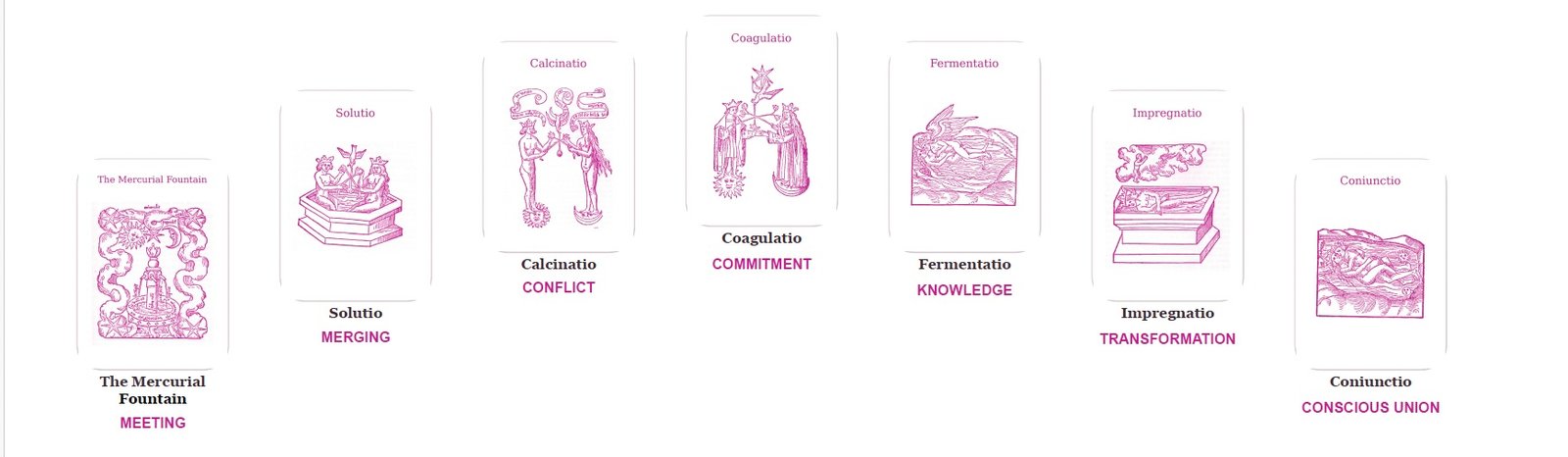
Carl Jung drew upon 16th-century alchemical images from the Rosarium Philosophorum to illustrate processes of psychological transformation and the movement toward greater wholeness. He used the images to explain the unconscious process that occurs between therapist and client. I expand this process of projection to couples. The images depict a king and queen moving through a mysterious process of union, conflict, dissolution, and transformation.
The Alchemical Couple is a seven-stage developmental framework I’ve developed within my approach to Couples Sex Therapy. Drawing inspiration from the symbolic imagery of the Rosarium Philosophorum and Jung’s psychological interpretation of alchemy, it offers a map for understanding how partners move through attraction, romantic merging, conflict, commitment, differentiation, and renewal.
The seven stages are not a rigid sequence or a checklist. Couples may revisit them throughout their lives. Each represents an opportunity for greater emotional awareness, relational connection, and erotic development.
1. The Mercurial Fountain: The Meeting Place
Every relationship begins with a meeting.
Something draws two people together. They arrive with their own histories, personalities, hopes, wounds, and unconscious expectations.
From an Imago perspective, romantic attraction can be influenced by unconscious patterns rooted in our earliest relationships. We may be drawn to people whose qualities feel familiar, even when we don’t fully understand why.
Our erotic attraction also emerges within this complex interplay of conscious preferences, bodily responses, emotional experiences, and unconscious associations.
The Mercurial Fountain represents this meeting place: the beginning of a relationship and the emergence of something new between two individuals.
Invitation: Tell your partner the story of how you first met. What attracted you emotionally and physically? What do you remember feeling?
2. Solutio: Falling in Love
Two separate worlds begin to merge.
In alchemy, solutio refers to dissolution, when a substance loses its fixed form.
Psychologically, this offers a metaphor for falling in love. Our usual sense of separateness temporarily softens as we become immersed in the relationship.
For many couples, sexual attraction is especially powerful during this stage. There is a heightened sense of anticipation and erotic connection.
But romantic love also involves idealization. We don’t yet see the full complexity of the person we’ve chosen.
Eventually, the intensity of early romantic attraction may soften, and our differences begin to emerge.
Invitation: Spend a few minutes gazing into each other’s eyes without speaking. Notice what it’s like to slow down and simply be present together.
3. Calcinatio: The Power Struggle
The heat of conflict reveals our differences.
In relationships, this stage corresponds to the power struggle. In alchemy, calcinatio involves fire. Psychologically, the heat of conflict burns away the illusion of sameness.
The person who once seemed so perfectly suited to us now feels frustratingly different. One partner wants more closeness while the other needs space. One wants to talk immediately after an argument while the other needs time to settle.
Differences around money, parenting, household responsibilities, affection, and sexual desire become recurring sources of tension.
Sexual intimacy can become entangled in these struggles. What began as a difference in sexual experience can become a painful cycle of pursuit, withdrawal, resentment, and disconnection.
We may try to change our partner, believing that if they would only behave differently, everything would be fine.
But the power struggle often reveals something deeper: our unmet needs, protective strategies, and unresolved experiences.
Instead of asking, How can I get my partner to change? we can begin asking:
What happens inside me when we disagree? What am I protecting? What might my partner be experiencing that I don’t yet understand?
Invitation: During your next disagreement, try an Imago Dialogue. Take turns speaking and listening. Mirror what your partner says before responding, validate their perspective, and approach their feelings with empathy.
The goal isn’t immediate agreement. It’s understanding.
4. Coagulatio: Choosing Commitment
Love becomes a conscious choice.
Commitment doesn’t mean resigning ourselves to an unhappy relationship. It means recognizing that lasting love requires intention, responsibility, and the willingness to work through difficulties together.
Conscious commitment does not mean tolerating abuse, coercion, or persistent violations of trust. It requires mutual responsibility and emotional and physical safety.
In alchemy, coagulatio describes the movement from a fluid state toward something more solid and formed.
After the disappointments of the power struggle, couples may confront an important question: Can I love this person as a separate individual rather than as the person I imagined they would be?
We begin to understand that we cannot control our partner, but we can change how we participate in the relationship.
This shift also has implications for sexuality. Rather than expecting sexual desire to remain unchanged throughout the relationship, partners can commit to understanding and nurturing their evolving erotic connection.
Invitation: Talk about what commitment means to each of you. What would help you feel more secure, supported, and invested in your emotional and sexual relationship?
5. Fermentatio: Creating Something New
Experimenting with new relational skills.
In alchemy, fermentatio symbolizes a process in which something new begins to emerge.
For couples, this stage represents the development of new relational abilities.
We begin to recognize familiar patterns before becoming trapped in them. We learn to repair after disagreements. We become more adept at expressing vulnerability rather than criticism.
Perhaps the partner who usually withdraws learns to stay emotionally present. The partner who tends to pursue learns to make requests without blame.
In the erotic relationship, partners may begin exploring new ways of communicating about desire, pleasure, boundaries, and sexual differences. Affection, sensual touch, playfulness, and curiosity can become valuable experiences in their own right.
The couple is no longer simply repeating the past. They are experimenting with new ways of relating.
Invitation: Try a 30-day Zero Negativity Challenge. Notice criticism, contempt, and dismissive behaviors, and practice replacing them with curiosity, appreciation, and respectful requests. When negativity occurs, acknowledge it and make a repair.
6. Impregnatio: Expanding the Relationship
Transformation creates room for new life.
In the symbolic language of alchemy, impregnatio represents the emergence of new possibilities.
For couples, this stage is about expansion.
As partners develop greater emotional security and self-awareness, they may discover greater intimacy, creativity, and personal growth.
They can support one another’s individuality without experiencing difference as a threat.
This can also transform their erotic relationship.
Long-term sexual intimacy becomes an evolving experience shaped by curiosity, trust, vulnerability, and the willingness to explore.
In Couples Sex Therapy, embodied practices can support this exploration. Mindful breathing, non-demand touch, sensate focus, and other consensual exercises can help partners become more aware of their own bodily experiences while developing greater sensitivity to one another.
As a sex therapist in Santa Monica, I integrate these practices to help couples cultivate greater emotional and erotic connection.
Rather than trying to recreate the relationship they once had, they begin creating the relationship they want now.
Invitation: Ask each other three questions: What are we enjoying in our intimate relationship? Where do we feel stuck? What would we like to explore together?
Listen without judgment or pressure to act immediately.
7. Coniunctio: The Alchemical Couple
Two individuals create a more conscious union.
At the beginning of a relationship, we may feel connected because we overlook our differences. In a conscious romantic relationship, we can experience connection because we have learned to manage and grow from our differences.
This is represented by the alchemical stage coniunctio, the union of opposites. We no longer need our partner to think, feel, or desire exactly as we do.
We can remain separate individuals while participating in a deeply meaningful partnership.
This is the paradox of mature love: greater individuality can make deeper intimacy possible.
Erotically, this may mean developing the capacity to experience both closeness and separateness, familiarity and novelty, security and adventure.
The symbolic marriage of opposites doesn’t mean that conflict disappears or that sexual desire becomes effortless. It means we have developed a different relationship to difference, vulnerability, and change.
We can meet each other with greater awareness, compassion, and freedom.
Invitation: Create a shared Relationship Vision that includes your emotional and erotic relationship. How do you want to communicate, express affection, navigate conflict, experience intimacy, and support each other’s growth?
Write your vision together and revisit it as your relationship evolves.
The Gold Is in the Transformation
The alchemists imagined that something precious could emerge through a process of dissolution, fire, separation, and reunion.
Our intimate relationships offer a similar possibility as we move through the developmental challenges of committed love.
The goal isn’t to eliminate conflict, increase sexual frequency, or recover the idealization of romantic love. It’s to expand our capacity for a more conscious, differentiated, emotionally connected, and erotically fulfilling relationship.
This work takes courage. It requires us to examine ourselves, listen to uncomfortable truths, and practice new ways of relating.
Relationships and Sexuality Develop Together
At Harvey Center for Relationships, we recognize that emotional and erotic development are deeply interconnected. Our approach integrates couples therapy and sex therapy to address the complexities of intimacy in long-term committed relationships.
Couples therapy often addresses communication, attachment, conflict, and emotional connection, while sex therapy focuses on sexual desire, pleasure, functioning, and intimacy.
A recurring argument may affect sexual desire. Sexual rejection may activate feelings of inadequacy or abandonment. Differences in desire may reflect not only individual sexual responses but also the ways partners navigate closeness, autonomy, vulnerability, and change.
At the same time, sexual difficulties may involve hormonal changes, medical conditions, medications, stress, trauma, or other factors that cannot be explained by relationship dynamics alone.
At Harvey Center for Relationships in Santa Monica, we bring these disciplines together through Couples Sex Therapy, an integrative clinical approach that addresses emotional, relational, and erotic dimensions together.
Our approach draws on contemporary sex therapy, attachment and developmental perspectives, Jungian psychology, Imago Relationship Therapy, and embodied practices.
The Alchemical Couple offers a distinctive symbolic and developmental framework within this broader approach, helping partners explore how their emotional and erotic relationships evolve together.
Rather than viewing a successful relationship solely in terms of reduced conflict or increased sexual frequency, this approach considers a broader question:
How can two people continue developing emotionally, psychologically, and erotically throughout a committed relationship?
Transforming Your Relationship
At Harvey Center for Relationships, we believe that lasting love is not something we simply find. It is something we continually create.
Through our integrated approach to couples therapy and sex therapy, we help partners transform conflict into understanding, disconnection into intimacy, and familiar patterns into opportunities for emotional and erotic growth.
Located in Santa Monica, near Venice, we provide in-person couples therapy and sex therapy for individuals and couples throughout Santa Monica, Venice, and the greater Los Angeles area.
Are you ready to discover the alchemy of your relationship?
Contact Harvey Center for Relationships to schedule an introductory consultation and discover how couples therapy and sex therapy can support your journey toward deeper connection and erotic fulfillment.